CDC K-6 Social Emotional Learning (SEL) Best Practices Study Redesign
Overcoming recruitment challenges and delivering a rigorous research design under political and timeline constraints
What you’ll see
How I diagnosed recruitment failure and reframed the study approach
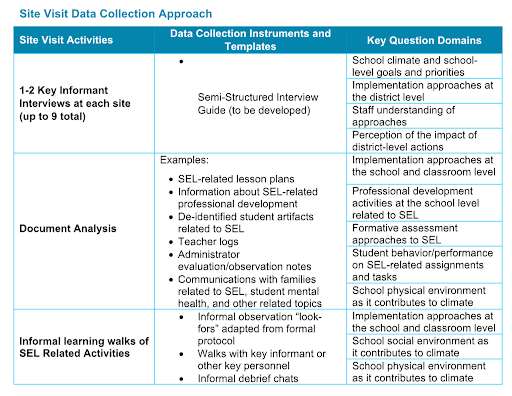
The redesigned method: district leader interviews + non-intrusive observation + debriefs + artifact review
How I secured participation from 9 districts across 9 states
The protocols I created (interview and observation guide) and how they improved feasibility
The outcome: successful recruitment and top government performance ratings (quality + project management)
Client: Centers for Disease Control and Prevention, Division of Adolescent and School Health
Timeline: June–December 2024
My title: Project Director
My role: Turnaround lead (study redesign + recruitment strategy + protocol development + team supervision + delivery quality)
Users / audiences: CDC stakeholders; district leaders (participants); research team (implementation); future districts and schools that would use the guidance if published
Methods: Key informant interviews with district leaders; non-intrusive school and classroom observations + debrief; artifact review; updated literature review
Sample / scope: 9 districts across 9 states (diverse geography and demographics)
Deliverables: Revised study design + protocols (interview + observation + site visit/debrief) + updated literature review + synthesized findings for client
Outcomes (high level): Secured participation late in the contract by removing high-burden elements; delivered a redesigned, feasible approach aligned to client goals; received highest government performance ratings across domains (quality and project management).
The problem
The project aimed to identify best practices in social and emotional learning (SEL) in K–6 schools nationwide, but participation was stalling late in the contract period. The original design was high-burden requiring student and family focus groups, and the post-pandemic political climate around SEL further increased districts’ reluctance to participate. Without a change, the project risked failing to meet the client’s learning goals within the final year of the contract.
What we needed to learn
What SEL practices and implementation conditions are most effective in K–6 contexts from a district leadership perspective?
What does “good SEL implementation” look like in school and classroom environments in a way that can be observed non-intrusively?
How can we gather credible evidence while reducing the burden and political sensitivity that prevents participation?
What I owned
After taking over as Project Director, I led a turnaround plan and owned:
Diagnosing why recruitment was failing (burden, sensitivity, feasibility under time constraints)
Redesigning the study approach in close partnership with the client
Creating updated protocols (district leader interviews, observation guide, site visit/debrief structure, artifact collection)
Securing district participation and managing relationships through the study
Conducting key informant interviews and supervising additional interviewing
Overseeing an updated literature review
Delivering high-quality outputs under a tight timeline
Research approach
To preserve rigor while increasing feasibility, I redesigned the study around a lower-burden, higher-trust participant experience:
Shifted primary participants to district leaders (reducing political and logistical risk while still accessing system-level implementation insight).
Designed a non-intrusive observation guide so site visits could capture implementation evidence without disrupting classrooms or requiring direct student and family data collection.
Added structured debriefs and artifact review with leaders to triangulate observations with policies, materials, and implementation supports.
This approach retained mixed evidence streams (interviews + observation + artifacts + literature) while removing the biggest recruitment blockers.
What we built
We produced a revised study model and field-ready toolkit, including:
A redesigned research plan aligned to CDC goals
District leader interview protocols
A non-intrusive school and classroom observation guide
Site visit and debrief protocol to ensure consistency across districts
An updated literature review to contextualize findings and align to best-practice evidence.
Impact
Participation secured: The redesigned approach enabled recruitment of 9 districts across 9 states, representing diverse geographies and school contexts.
Methodological strength: a validated redesign that improved feasibility without sacrificing credibility.
Feasibility + rigor achieved: The study met client learning goals despite end-of-contract timing and the shifting political environment.
Delivery excellence: The client awarded the project the highest government ratings across domains, including quality and project management.
What I Learned
This project sharpened my ability to redesign research in real time while balancing methodological rigor with participant experience, political context, and tight delivery constraints. It reminded me again that adoption is part of research quality. A plan can make perfect sense on paper, but if it is too burdensome or feels too risky for participants in that moment, it will not produce usable evidence. The turnaround came from redesigning the research experience without losing what we needed to learn, and it only worked because I stayed in close partnership with the client through change, using fast feedback loops and transparent tradeoffs to keep the work credible and deliverable.